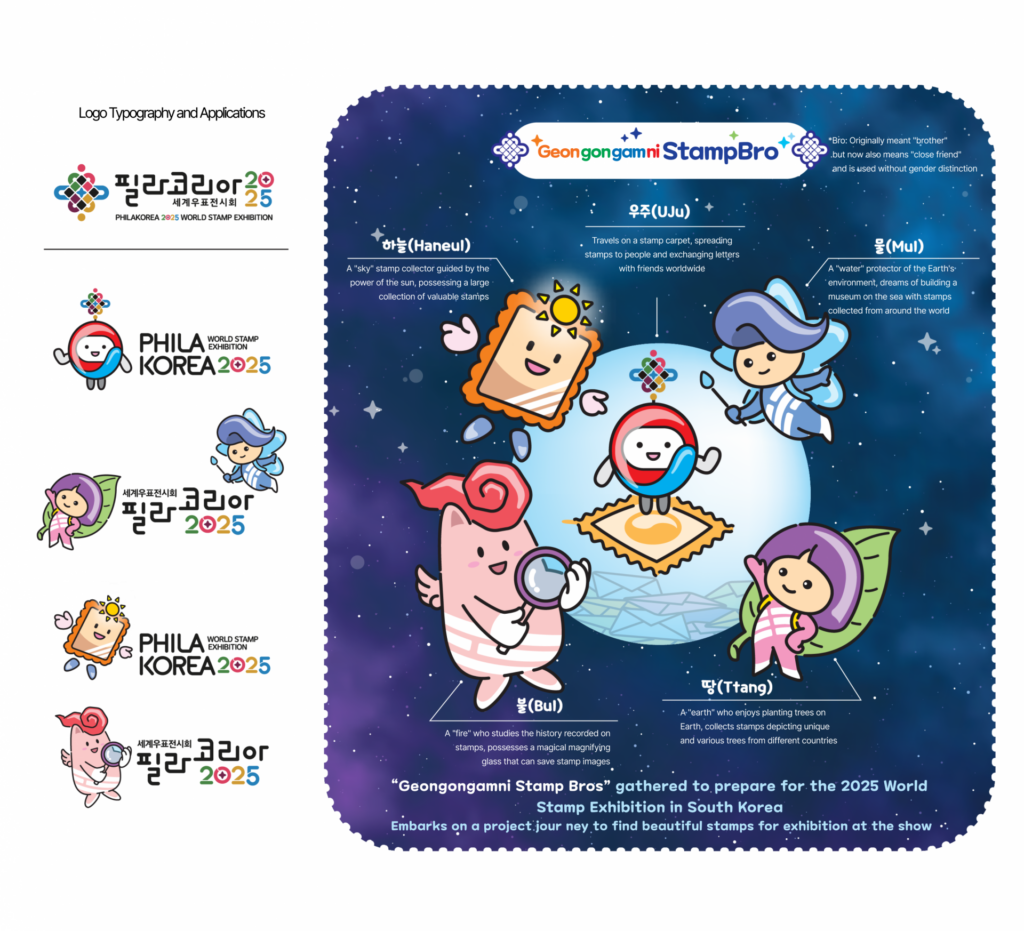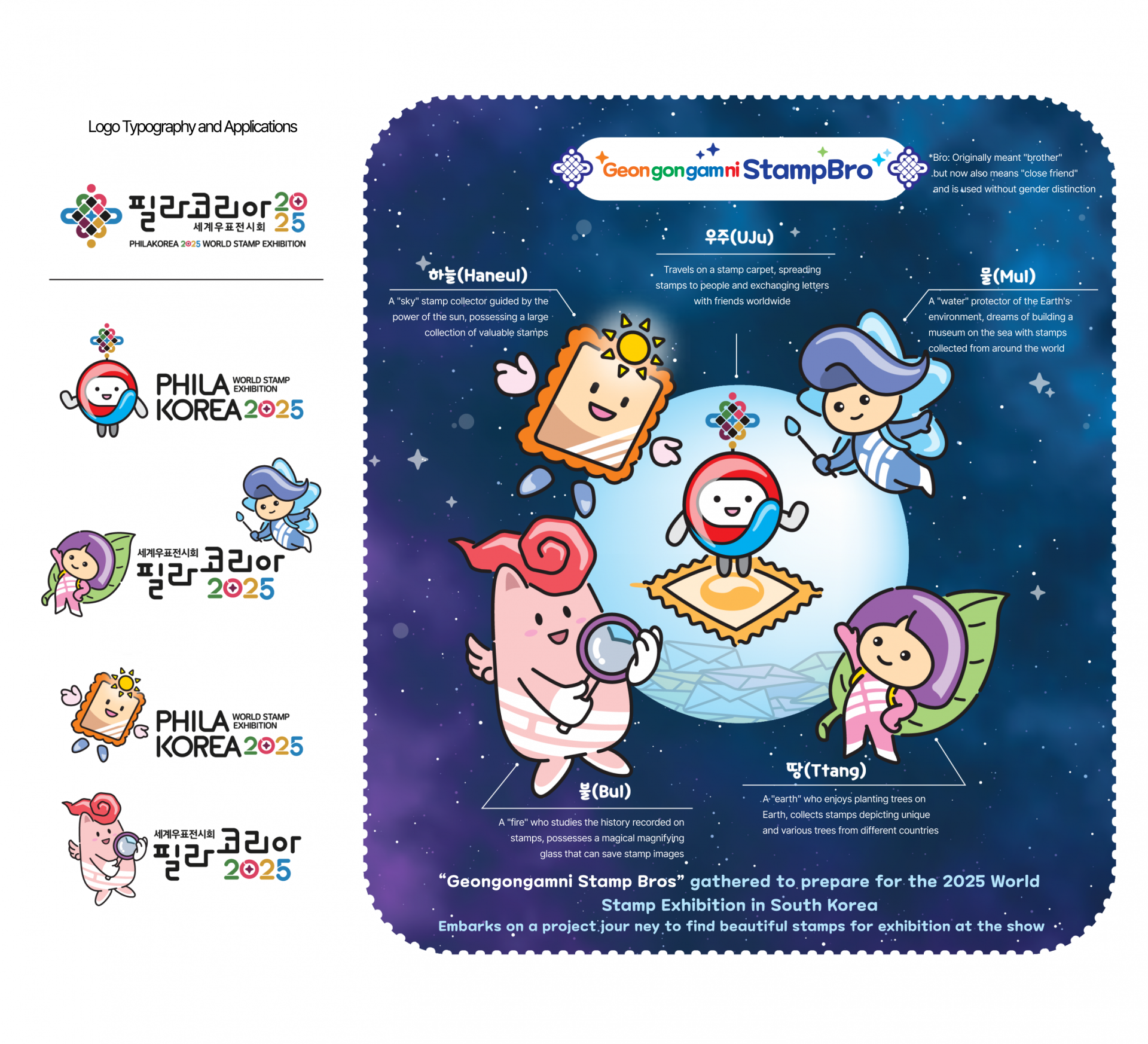
Every international stamp show apparently needs to have mascots, and Phila Korea excelled in having five of them – the “Geon-go-gam-ri Stamp Bro” crew.
That in itself is not an innovation. However, my visit to the Stampfinity booth of Austria, revealed one innovative marketing product – Korea’s first cryptostamp. In actual fact, however, the five cryptostamps (Figure 2) specially produced for the Seoul show were more properly cinderellas, i.e., the 21st century version of a promotional label.
I have dipped into the whole cryptostamp world – briefly – in the past, but Seoul offered me the opportunity to speak not only with the producers of the PhoilaKorea cinderellas, but the actual innovators of cryptostamps.
I had the good fortune to meet Managing Director Michael Dorner and Project Manager Anja Derkits of stampfinity, a division of the Austrian company, Variussystems digital solutions. Anja, in conjunction with the PhilaKorea organizers, designed the five cinderellas.

Publicity flyer for the PhilaKorea mascots.





The Geon-gon-gam-ri Stamp Bro cryptostamps.
In 2019, Varius Systems worked together with Austrian Post to issue the world’s first cryptostamp. The experiment was obviously a success, as multiple postal administrations have had cryptostamp issues. Judging by the prices that some of these issues fetch, plus the speed with which certain new issue variants sell out, this is a new collecting area in philately. The difference is that most “old school” collectors either know nothing about them, or, like myself, basically do not understand what the crypto element is. In my ignorance, I always associated “crypto” with crypto currency, like Bitcoin. So what was the relevance of the term when it came to its use in the world of stamp?
Fortunately, Martin and Anja quickly made it very clear that I needed to stop thinking that Bitcoins were in any way relevant to their innovation, except for one important element. The point of cryptostamps is that by incorporating blockchain technology into the physical “card”, the chances of anyone being able to counterfeit the stamps was essentially zero, or as one source put it.
“A crypto stamp is a physical stamp that is connected to its digital twin stored in a blockchain network. (More about the taxonomy of digital philatelic products here.) This digital twin is typically in the form of a non-fungible token (NFT), which represents a unique and verifiable digital asset. By linking the digital and the physical counterparts of this product, the security-related advantages of the blockchain technology get transferred onto the physical stamp, making it counterfeit-proof. Moreover, this linkage enables collectors to engage with stamps in new, exciting ways.”
Now we come to the (for me, at least) tricky part: the physical-digital connection. Anja explains:
Regarding the NFC: NFC stands for Near field communication and refers to the NFC Chip that is integrated in the product. Near field means that the chip only can be recognized by devices in a very close area, so you do not have to worry this is not the kind of chip that does tracking or other functions. The chip can be read out / scanned by any smartphone built after 2016, as it uses the same technologies that smartphones use for contactless payment. The chip is integrated as a security feature to protect our stamps from being counterfeited.
To check the authenticity of your stamp you can open the settings in your smartphone search for “NFC” and enable the function, then just hold the stamp close to your smartphone (mostly backside of the phone) and a small pop up window with a link should appear. Click on the pop up and the verified product landing page should appear.
I failed completely to find “NFC” in my post-2016 Iphone settings, so instead I scanned the QR code on the back of the “Bro” cryptostamp. Note that the serial code [1], and the activation code [A] have been deliberately obscured in the image, and the secret wallet key [2] has not been revealed as the self-adhesive cover is still intact. The resulting NFT is shown in Figure 3 – the stamp’s digital twin. If the “Bro” stamp had been an official issue, then you could add this NFT to your crypto wallet (or “cryptostamp album”) as it would have value.
It is important to point out that although in some ways it may look like a trading card – think Pokémon, baseball cards, etc. – but integral to the “card” there is a self-adhesive stamp. If this was an official stamp issue, (unlike the PhilaKorea cinderellas) with a face value, it would be valid for use on items sent through the mail.
Although it may not be the most sensible way to treat cryptostamps, in terms of destroying the integrity of the whole unit, the integral stamps do appear on official first day covers. After all, if it’s an official issue, there will always be an FDC. However, I am not aware of any first day covers with Korean PhilaKorea issues which incorporated one of stampfinity’s cinderellas – but you never know!
In terms of stampfinity’s decision to produce these cinderellas for PhilaKorea, each in a total issue of 1,000 pieces, Anja commented:
We normally do not produce Cinderella stamps. This has been a new trial for us as well, since we really just want people to be able to get in touch with the product and have the opportunity to learn what it is. I have no clear decision if we will do something like this again in the future or not.
Reference : Korean Philately, 62-1, the journal of the Korean stamp society. wew.koreastampsociety.com